Rowan
The Salt PathRowan is Ray and Moth’s adult daughter, whose relationship with her mother changes as the family loses its home and Ray and Moth take to the South West Coast Path. She is both a worried daughter confronting the dangers of her parents’ plan and a capable young woman making her own way. Her calls mark a shift in the family’s roles: Ray can no longer protect Rowan from hardship, while Rowan finds ways to care for Ray across the distance.
Identity and family context
When Ray and Moth win a used-once, three-kilogram Vango tent in an eBay auction for thirty-eight pounds, Ray is eager to tell Rowan. The tent is to be their home for the rest of the summer and perhaps longer, and the purchase offers a small burst of hope after weeks of gloom. Ray phones not only to share the news but to recover, for a moment, the familiar role of a mother who can make things all right.
That impulse collides with what the family has lost. Rowan and her brother, Tom, are grown, but the home was theirs too; Moth is their father, and his illness is painful for them as well as for Ray. Ray recognizes that she cannot shield her children from what is happening. The old balance is shifting, and she experiences that change as a threat to the last part of herself she still recognizes. Rowan’s significance therefore lies not only in being one of the people Ray loves, but in making visible the limits of Ray’s former identity as the family’s protecting parent.
Her response to the walk
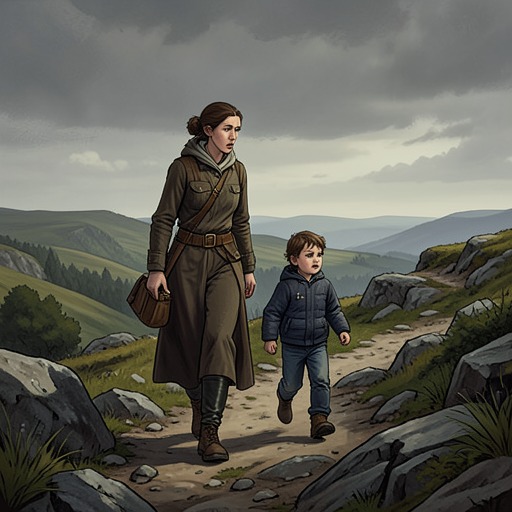
Rowan challenges the plan to live in a tent and walk the coast. Her concerns are concrete: Moth might fall from a cliff, he can barely get up from a chair some days, the couple have no money for food, campsites cost money, and Ray has not yet told Tom. She also asks how they would manage if Moth became unable to move while on a cliff. The questions convey an adult daughter’s clear-eyed attention to practical and physical risks, rather than mere resistance to an unconventional decision.
Ray answers that they cannot sit waiting for a council house and that they need the journey; as long as she and Moth remain together, she believes they will be all right. Rowan does not make the danger disappear or pretend to approve. Instead, she offers a form of care suited to the situation: she will send Ray a new mobile phone, asks her to call every day, and insists that she answer when Rowan calls. The new phone matters in particular because the old one’s battery lasts barely ten minutes. Rowan also tells Ray to inform Tom, extending her concern beyond the immediate conversation and toward the family’s need to stay in contact.
Distance and independence
Later, during rain in Rocky Valley, Ray and Moth shelter beneath a rock overhang when Rowan calls from Venice. She is travelling to a late-summer job in Croatia but believes she may have missed her connecting bus. The scene reverses the earlier pattern of concern: Rowan is now the one stranded abroad, and Ray is physically unable to intervene. Ray recalls that, as a parent, she and Moth would once have sent money to get Rowan onto a flight and make her safe. In their new circumstances, she can only listen and talk with her daughter from a crevice in the rocks.
Rowan’s panic makes the distance painful, but the call ends without the feared loss. She tells Ray that the bus has arrived after all; it was late, not missed. Her farewell—“Love you, Mum, be safe …”—joins affection with an injunction to protect herself. Ray curls up on the rock ledge and sobs, and Moth holds her until she can breathe again. Rowan’s call thus reveals both the limits of Ray’s ability to rescue her and the continuing intimacy that can pass between them without material help.
At St Materiana’s Church, after the couple have left a campsite where they spent two nights, Rowan calls again. She has been offered a job with a public-relations company in London, and it needs her to start straight away. She is already on the train and has worked out how to get back. The episode presents her as resourceful in action: the practical problem of returning is already being solved by the time Ray hears about it.
Change and narrative significance
Across these encounters, Rowan is neither simply dependent on her parents nor detached from them. She worries about Moth’s vulnerability and the couple’s lack of money; she arranges a more reliable phone and asks for daily contact; she also navigates travel trouble and a sudden job opportunity herself. The evidence does not suggest that the family’s attachment has weakened. Instead, the form of care changes as Ray and Moth lose the stability that once allowed them to protect their children materially.
For Ray, this change is especially difficult because motherhood has been bound to being the hand that protects and keeps her children’s lives safe. Rowan’s competence challenges Ray’s wish to preserve that role, while her calls keep their relationship active across physical distance. Her storyline places the walk’s hardship beside the ordinary, consequential transitions of adult life: a trip to a summer job, a delayed bus, and an unexpected offer in London. Rowan’s independence does not cancel her place in the family; it makes the relationship newly reciprocal, even when Ray feels helpless.